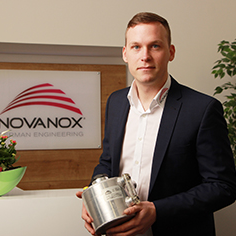
Stainless Steel AdBlue Tanks for Machinery, Plant, and Vehicle Technology
Stainless steel AdBlue tanks are used for storing and dispensing AdBlue in machinery, plant, and vehicle technology (vehicles). AdBlue is a mixture of urea and distilled water. This mixture is injected into the exhaust gas stream to help reduce nitrogen emissions.
In addition to legal guidelines, stainless steel AdBlue tanks must meet a variety of requirements. In daily operation, stainless steel AdBlue tanks are constantly exposed to mechanical stresses, vibrations, and temperature fluctuations. The demands on strength are further increased by complex designs aimed at maximising filling volume.
Custom Stainless Steel AdBlue Tanks from NovaNox®
Leveraging our proven expertise in tank technology, we develop and manufacture specialised stainless steel AdBlue tanks for producers of machinery, plant, and vehicle technology. With the aid of our modern manufacturing capabilities, we produce AdBlue tanks in both simple and complex shapes, as each tank must fit its individual installation situation.
NovaNox® stainless steel AdBlue tanks are always precisely tailored to the specific installation possibilities in each individual case. This ensures optimal utilisation of confined installation spaces, while also maximising the filling volume of the AdBlue tank.
Installation-Ready Stainless Steel AdBlue Tanks from NovaNox®
Whether it's tank lids, level indicators, sensors, or fuel filters – as a system supplier, we deliver stainless steel AdBlue tanks as installation-ready system solutions. We manage component procurement with full cost transparency, as well as schedule monitoring, quality control, and final assembly.
By overseeing the entire process, we maximise fitting accuracy. This makes final assembly very convenient and reduces assembly times to a minimum. Direct procurement channels also optimise the entire supply chain.
Lightweight Stainless Steel AdBlue Tanks from NovaNox®
In contrast to conventional stainless steel AdBlue tanks, lightweight NovaNox® AdBlue tanks are made from high-quality thin stainless steel sheet. This particularity enables significant weight savings, especially in vehicle technology and aerospace engineering. Weight reductions lower fuel consumption and the resulting operating costs.
Despite their lightweight construction, our stainless steel AdBlue tanks, manufactured with thin sheet metal, possess high strength. This quality characteristic is ensured by our in-house welding process planning.
Manufacturing Processes
Manual Welding
The skilled personnel of our experienced welding specialist company are proficient in welding technology. Our employees manufacture both automatically welded and manually welded stainless steel AdBlue tanks. For single custom-made items, as well as small and medium-sized series, the manual welding process has proven to be a cost-effective alternative with quick turnaround times. We produce the hand-welded stainless steel AdBlue tanks on modern welding tables. Since we construct the fixtures ourselves, we can consistently guarantee maximum precision and repeatability, even with high tolerances.
Automated Welding
Automated welding is performed by state-of-the-art welding robots. The digitised manufacturing process ensures very fast and efficient production. This provides ideal conditions when high demands for consistent quality need to be produced cost-effectively. Automated welding is the most precise welding method. This allows for the realisation of even very complex stainless steel AdBlue tanks with high tolerance requirements.
Corrosion Protection and Finishing for Stainless Steel AdBlue Tanks
Surface treatments ensure durability, safety, and an appealing aesthetic. A long-lasting, rust-free, safe, and stable surface supports the longevity of stainless steel AdBlue tanks. Additionally, it enhances the visual appeal of the stainless steel AdBlue tanks. Our in-house powder coating and painting facility allows for high-quality surface designs in all RAL colours within the shortest possible time. For optimal corrosion protection, we recommend heat-resistant protective coatings, powder coatings, pickling, or passivation.